

Around twenty minutes past six on the evening of Wednesday, December 14, while exercising with her dogs at a Royal Thai Army event in Pak Chong district northeast of Bangkok, Princess Bajrakitiyabha suddenly lost consciousness and collapsed. Her heart stopped beating and she stopped breathing.
Bajrakitiyabha’s personal nurse, who accompanies her wherever she goes, was unable to revive her. A soldier performed CPR on her for more than an hour as she was rushed to Pak Chong Nana Hospital.
By the time she arrived at the hospital, her situation was already hopeless, despite the heroic efforts to keep her alive with CPR. When the brain is deprived of oxygen, permanent damage begins within five minutes, and brain death usually occurs within 10. Bajrakitiyabha had been starved of oxygen for far longer than this.
Nevertheless, doctors made frantic efforts to try to save her. The princess was connected to an ECMO machine, which is used to treat people with profound heart and lung failure, by circulating and oxygenating blood outside the body.
When he was informed of the seriousness of the situation, King Vajiralongkorn raced to Pak Chong in a military helicopter, arriving towards midnight. Meanwhile the best intensive care medical helicopter in Thailand, registration HS-BHQ, was sent to Pak Chong too.
I first heard about what was happening from palace sources as the helicopters were heading towards the hospital, and after I verified the information I broke the news on Facebook and Twitter, and have been publishing regular updates ever since.
When he arrived at the hospital, Vajiralongkorn was distraught when he realised how bad things were. He told doctors to continue to do whatever they could, even though it was clear his daughter was already beyond help. Eventually, with no improvement in her condition, a decision was made to bring Bajrakitiyabha back to Bangkok.
In the early hours of Thursday, December 15, medical helicopter HS-BHQ left Pak Chong with Bajrakitiyabha aboard. For the flight back to Bangkok it was flanked by two military helicopters, one of which was carrying Vajiralongkorn. To try to maintain secrecy, HS-BHQ did not file details of its departure and arrival locations, but its journey could still be monitored on flight tracking apps.

The helicopter landed at Bangkok Hospital around 2:15 am, and then Bajrakitiyabha was transferred to Chulalongkorn Hospital by road. The reason for the decision not to fly directly to Chulalongkorn is unknown. It may have been that they were trying to preserve secrecy, not yet knowing the story had already been reported and we were tracking the helicopter in real time.
By the time Bajrakitiyabha arrived at Chulalongkorn Hospital she’d had no brain function for at least nine hours. Her heart and lungs were still not working. Desperate intensive treatment continued but she was clearly beyond saving.
After her collapse at the dog training event, it had been assumed that she’d had a heart attack, because her heart had indeed stopped beating. But doctors at Chulalongkorn Hospital realised that in fact the princess had suffered a brain aneurysm causing a massive subarachnoid haemorrhage.
What this means is that a narrowed or weakened artery in Ong Bha's brain had caused a balloon of blood to accumulate at the weak point in the artery. This had probably been going on for several years but because it didn't cause any apparent symptoms nobody would have known about it. Meanwhile the balloon was silently but relentlessly growing and sooner or later it was bound to burst.
The princess unknowingly had a ticking time bomb in her brain, and on December 14 it exploded. Her skull was flooded with blood, which in turn caused cardiac and respiratory arrest.
Once this had happened, in provincial Thailand miles from a hospital, not even the best neurosurgeon in the world could have saved her.
It was not until around midday on Thursday that doctors at Chulalongkorn dared to formally pronounce Ong Bha brain dead, but this fact has remained secret. On the orders of the king, Bajrakitiyabha continues to be kept technically alive by the ECMO machine. But she will never ever wake up.
As an ICU and trauma specialist consultant explained to me:
The ECMO basically makes the blood circulate in the body, the blood is oxygenated outside in a machine. The blood pressure from the ECMO can indeed maintain the body cells alive. But the brain does not come back from this damage, both from the subarachnoid haemorrhage and also from the lack of proper oxygenation to the brain for hours.
On Thursday afternoon, the palace finally issued a statement on the health of the princess. As usual with royal health bulletins, it was mostly fiction. It said that she had lost consciousness as a result of a heart condition, but that her condition had stabilised in hospital at Pak Chong and she’d subsequently been transferred by helicopter to Chulalongkorn Hospital where she was undergoing checks. It failed to mention that there was no hope of recovery.
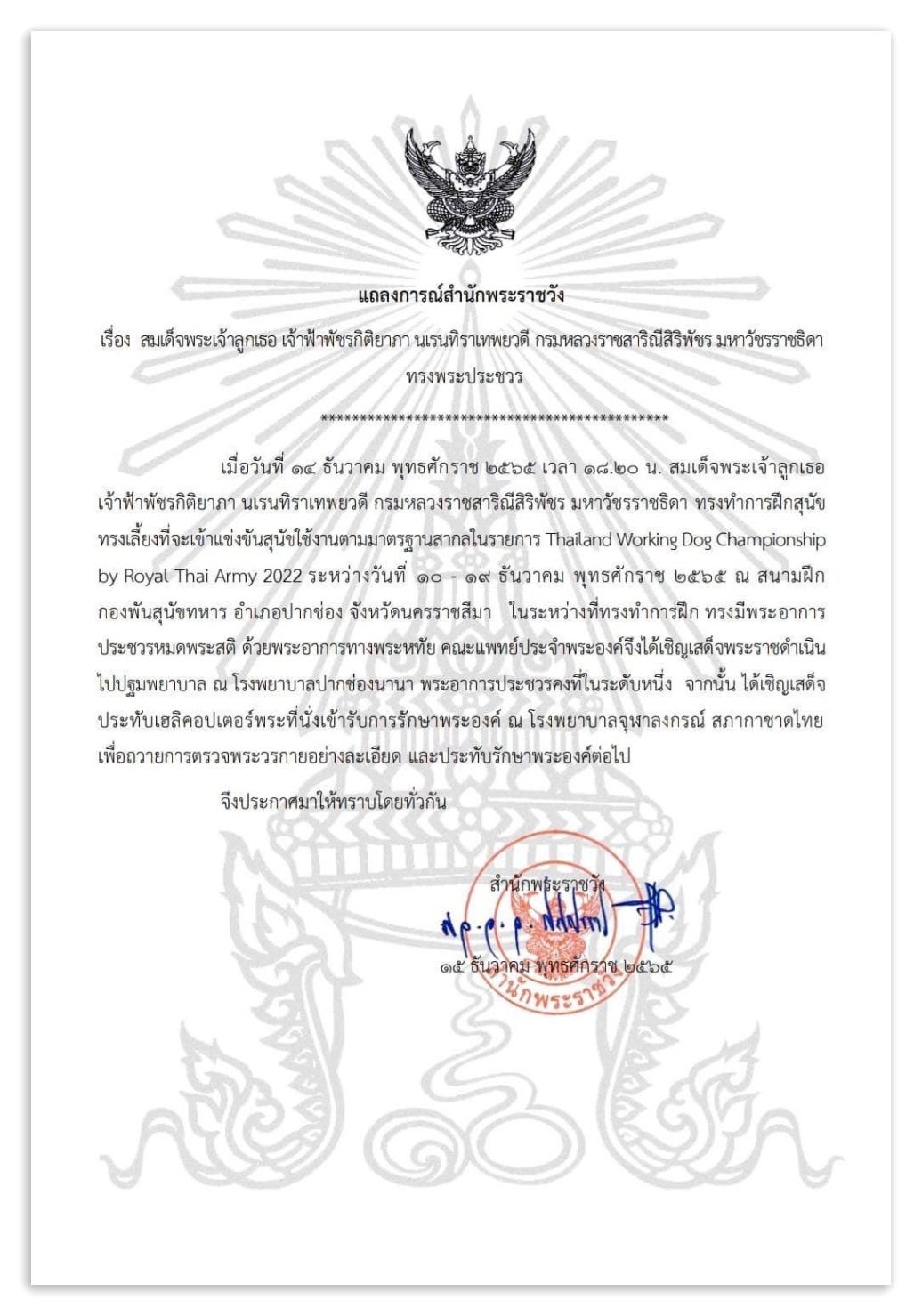
Vajiralongkorn visited his daughter in hospital four times on Thursday, and again on Friday accompanied by Queen Suthida. Both were visibly exhausted and devastated as they left.
Vajiralongkorn and his daughter had huge affection for each other, and Bajrakitiyabha was also close to Suthida and probably her biggest ally and defender in the palace.
Later that day, the palace announced that the king and queen had caught the coronavirus and would suspend royal duties for the moment.

Meanwhile, Thais across the country have been urged to pray for Bajrakitiyabha’s recovery. Prime minister Prayut Chan-ocha and other senior ministers have visited Chulalongkorn Hospital to prostrate and present offerings at a large portrait of the princess. Military units have held mass ceremonies on their knees, exhorting help from the heavens. Civil servants and local administrations in all provinces have been ordered to organise religious ceremonies for the princess, as well as other initiatives such as donating alms to monks and releasing fish and animals that were due to be butchered. The supreme patriarch has told every temple in the kingdom to hold an extra ceremony each day. Christian and Muslim leaders have also mobilised their communities to offer prayers.
But this is all just a charade, because as the palace and regime are well aware, Bajrakitiyabha has been dead since December 14 according to any sensible definition of what it means to die.
A second palace health bulletin on December 19 indirectly acknowledged the princess’s condition. It said she had not regained consciousness and “medicine and equipment” were being used to support her heart, lungs and kidneys. This was an oblique way of saying that she is being kept alive by an ECMO machine.
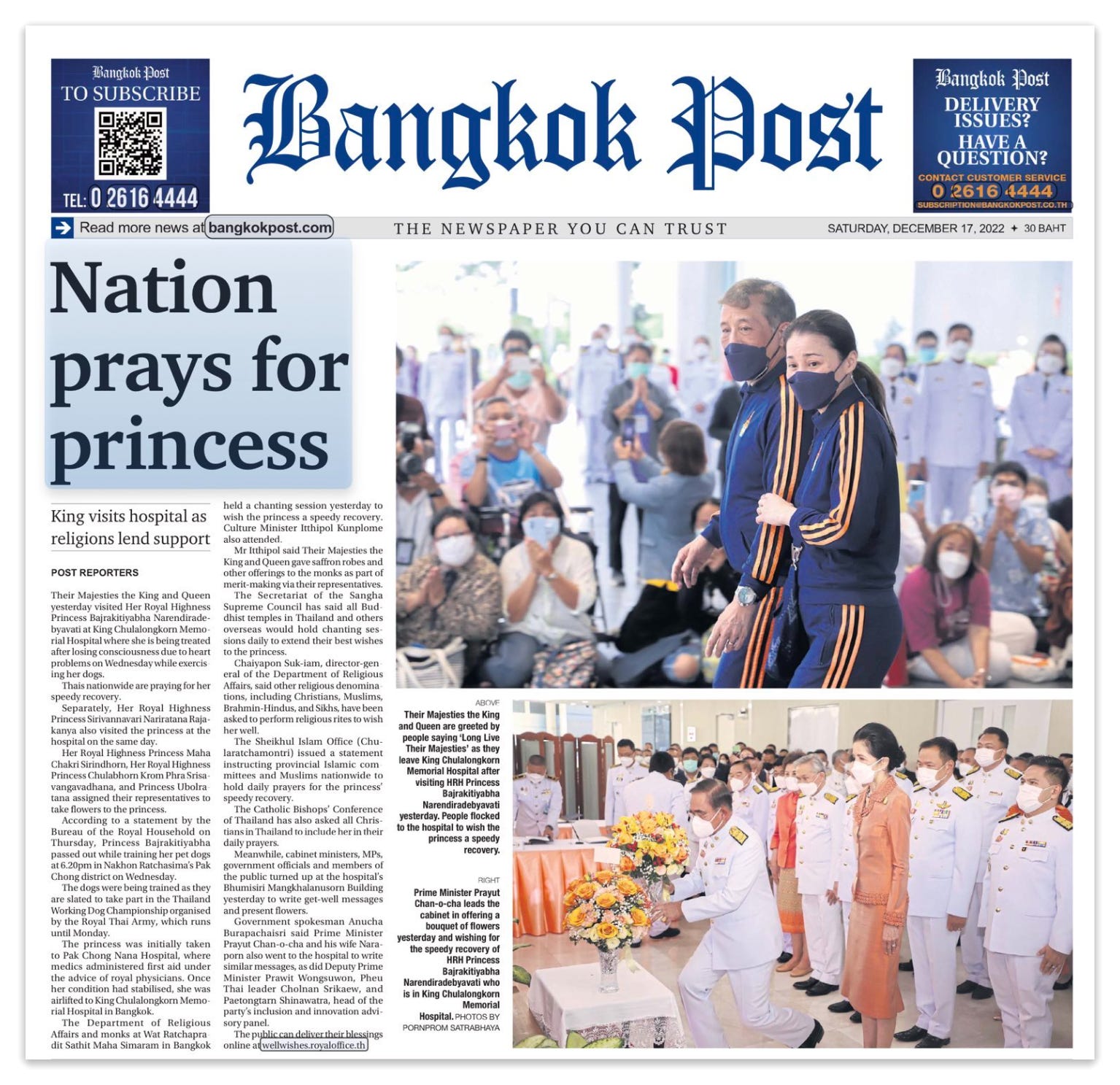
It’s not clear how long this will continue. Several royal sources say the princess may be kept artificially alive for at least a couple of weeks until early January. The palace is worried that disruption to the New Year celebrations, after two years of economic agony because of the pandemic, would drag the popularity of the monarchy even lower. Delaying the announcement also allows them to exploit the plight of the princess to stir up royalist fervour across the country.
The news that the king and queen have covid — whether true or invented — also means announcement of Bajrakitiyabha’s death is likely to be days or weeks away.
Once her death is officially announced, the period of strict mourning is likely to be relatively brief, probably no longer than two weeks. Even during this period shops and restaurants will remain open but some entertainment venues will close, or at least operate more discreetly.
There will be further mourning for months afterwards but this will mainly just require officials to wear black clothing or armbands, plus plenty of additional royalist propaganda being pumped out. It won’t really affect the everyday lives of most Thais or tourists at all.
When King Bhumibol died in October 2016, there was a month of strict mourning in which Thais were told to avoid taking part in so-called joyful activities, and the full mourning period lasted a year. Mourning for Bajrakitiyabha will be significantly less stringently enforced, and the economic damage to the crucial tourism and hospitality industries will be relatively limited, although if New Year celebrations are cancelled it would be a significant blow to many businesses. The regime will be keen to limit the economic fallout — it’s simply not sustainable after the damage already wrought by covid-19.

As everybody knows I am opposed to the monarchy’s role in undermining democracy in Thailand, and I am no fan of Vajiralongkorn, but the death of Bajrakitiyabha is a personal tragedy for all of the royals and they deserve compassion and space to grieve. Nobody should celebrate her death.
But the people of Thailand also deserve to be told the truth, instead of being dragged into days or weeks of royalist theatrics to pray for the impossible resurrection of a woman who has already been brain dead for days and who has no chance of recovery.
So I am not writing about Bajrakitiyabha’s death to mock or taunt the royal family. I’m just doing my job as a journalist to try to provide reliable information to Thais because they can't get this from other sources, least of all the palace or the regime.
It’s also important to analyse what the death of the princess means for Thai royal succession and the future of the dynasty. It had been widely assumed that Bajrakitiyabha would be the next monarch after the death of Vajiralongkorn, or at the very least would act as regent on behalf of her younger half-brother Dipangkorn, whose severe autism means he can never really reign alone.
To help navigate the complex issue of royal succession, a friend has produced a superb chart showing the relevant dynastic history that brought us to this point, and our best guess of the likely line of succession. It’s so big and detailed that I can’t post it as an image, but it is an invaluable guide to the future of the monarchy, and you can download it as a PDF here:
The rest of this post will discuss the implications of Bajrakitiyabha’s death for Thai politics, the game of thrones in the palace, and the future of the Chakri dynasty.
If you would like to support my journalism you can subscribe here:
Thanks!
1. Royal blood
The reason there is so much uncertainty over who will succeed Vajiralongkorn is that he’s had such a tumultuous private life that there are several possible candidates. To analyse Thai royal succession dynamics, we have to start with a history of the king’s marriages. The role of Bajrakitiyabha in the shifting royal succession dynamics over the decades is also crucial.
Between 1972 and 1976, Vajiralongkorn studied at the Royal Military College at Duntroon in Australia. During his time there, he fell in love with Laksasubha Kridakara, the daughter of a diplomat at the Thai embassy. This caused major family rows, especially with Vajiralongkorn’s mother Queen Sirikit, who didn’t regard Laksasubha as a suitable bride.
Sirikit was determined to ensure that her branch of the royal family, the Kitiyakara clan, would become the dominant royal bloodline in future generations. She was insistent that Vajiralongkorn should marry his own cousin, Sirikit’s niece Soamsawali Kitiyakara.
Arguments about the issue divided the palace during the turbulent year of 1976, when the royal family, terrified of being overthrown like the monarchies in Laos and Cambodia, sided with the military and far-right nationalists to destroy Thailand’s nascent democracy, leading to the massacre of student protesters at Thammasat University in October 6 that year.
Vajiralongkorn was brought back to Thailand a few days before the massacre. In December 1976, Thai newspapers announced his engagement to Soamsawali, and on April Fool’s Day 1977 they were married in Bangkok. He was 24 and she was 19.
In The King Never Smiles, Paul Handley explains the dynastic reasons why Sirikit demanded that Vajiralongkorn marry Soamsawali:
Somsawali represented not only the dynastic ambitions of the Kityakaras but also those of the Sanitwongs family of Sirikit’s mother, and a third prominent royal line at risk of marginalization, the heirs of King Chulalongkorn’s son Prince Yugala. Somsawali’s mother was MR Bhandhusawali Yugala, whose own mother was a Sanitwongs. For the three families’ dynastic aspirations, Somsawali was genealogically near perfect.
But there were several problems with the relationship from the start. Because the Thai monarchy is essentially a blood cult, in which people with a supposedly purer royal bloodline have higher status, there was significant inbreeding in the family over successive generations. Soamsawali was Vajiralongkorn’s cousin via Sirikit’s side of the family, and was more distantly related via Bhumibol too. As Handley says:
Genetically she was a potential disaster. In a dynasty deeply defined by endogamous marriage and mating, the king and the queen were closely related direct descendants of King Chulalongkorn. So Somsawali had much the same blood as the prince.
Also, Vajiralongkorn was never interested in Soamsawali, who he found plain, boring and clueless. He only married her to please his overbearing mother. After their wedding the couple toured Thailand to try to boost support for the monarchy after the horror of the massacre. But the marriage soon fell apart.
The king gained a reputation for womanising and partying with gangsters and corrupt tycoons, and became besotted with aspiring actress Yuvathida “Benz” Polpraserth. During 1978, Soamsawali became pregnant, but soon afterwards Vajiralongkorn abandoned her to live with Yuvathida in a different palace.
Soamsawali gave birth to Vajiralongkorn’s first child on December 7, 1978. It was a daughter — Bajrakitiyabha.
The opening scenes of the 1980 BBC documentary Soul of a Nation, which I wrote about in detail last year, show extraordinary footage of the the naming ceremony for the infant Bajrakitiyabha, with Bhumibol symbolically cutting off a lock of her hair and pouring lustral water over her head as a conch shell is blown. It’s well worth watching.
She was of impeccable royal lineage, with ancient Chakri bloodlines on both her father and her mother’s side. But the fact she was a woman made it unlikely she would ever be monarch. And Vajiralongkorn’s antics soon made her prospects even less probable.
2. Four banished brothers
Less than 10 months after Bajrakitiyabha’s birth, Vajiralongkorn’s second child was born, on August 29, 1979. It was a son, Juthavachara. Vajiralongkorn now had a male heir — but the mother was Yuvathida. Even though technically Juthavachara was much less royal than Bajrakitiyabha, because his mother was a commoner, the fact he was male put him first in the line of succession. Sirikit was appalled — her dynastic ambitions were now in tatters.
As Handley says:
For Queen Sirikit this was a disaster: the boy threatened her own family’s dynastic hopes, unless Soamsawali gave birth to a celestial prince.
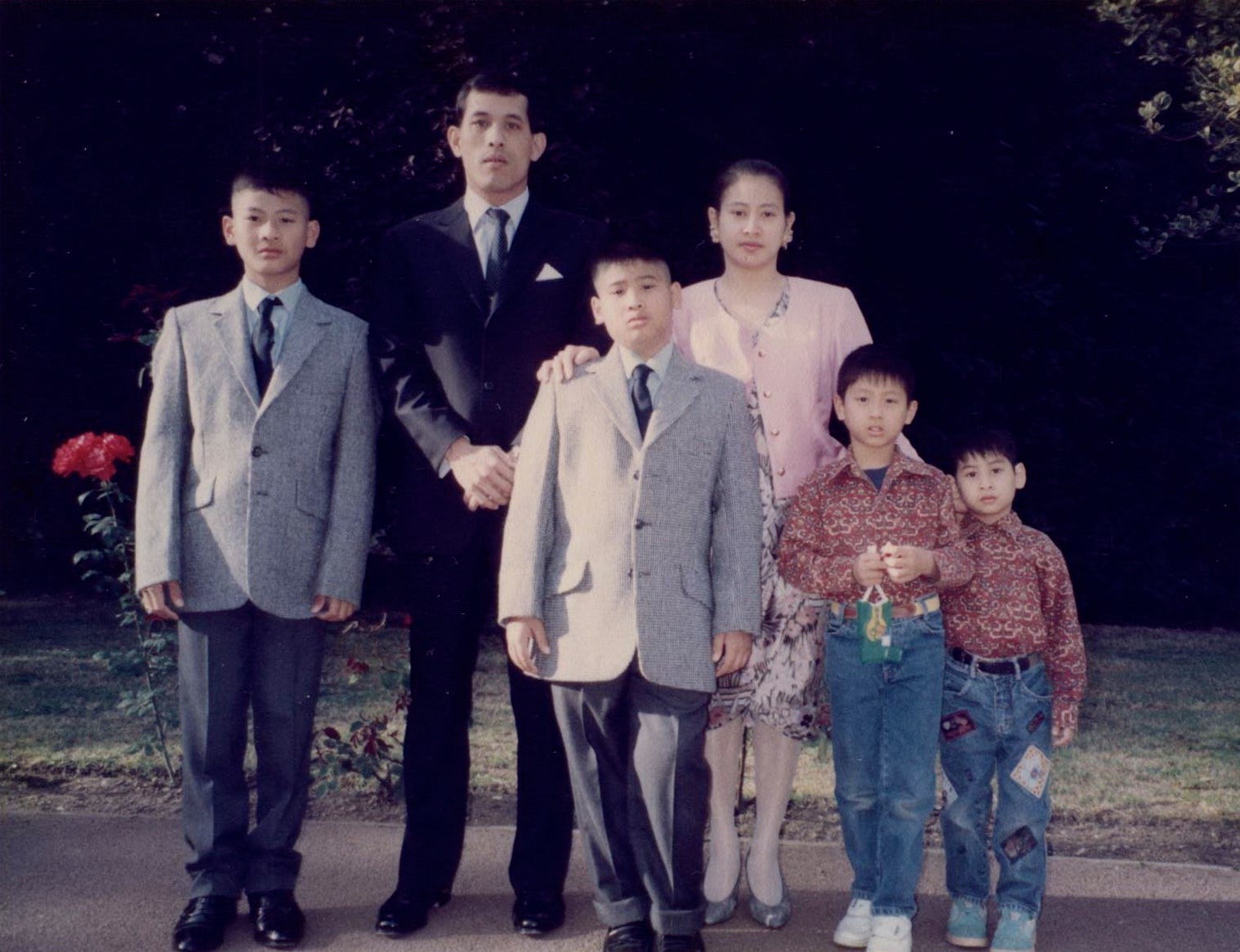
There was little prospect of Soamsawali having any more children with Vajiralongkorn. He was living with Yuvathida, and over the next decade the couple had four more children. There were three more sons — Vacharaesorn, Chakriwat and Vatchrawee — and then a daughter, Busyampetch.
With four male heirs, the prospect of Bajrakitiyabha ever becoming monarch now seemed incredibly remote.
Sirikit began publicly criticising her son’s behaviour to foreign media. At a press conference in Texas in 1981 she said:
My son the crown prince is a little bit of a Don Juan. He is a good student, a good boy, but women find him interesting and he finds women even more interesting… If the people of Thailand do not approve of the behaviour of my son, then he would either have to change his behaviour or resign from the royal family.
Bhumibol and Sirikit eventually agreed to allow their son to formally leave Soamsawali, and the divorce was finalised in 1993.
Vajiralongkorn quietly married Yuvathida in February 1994, and the relationship was officially announced on his 42nd birthday on July 28 when he appeared in public with his new wife and their five children to make merit by releasing birds and fish.
But by now, Vajiralongkorn’s relationship with Yuvathida was under severe strain. He had always been a relentless womaniser, and expected her to accept this without complaint. It led to explosive rows, and the situation worsened after Vajiralongkorn became infatuated with a new concubine, Srirasmi Suwadee, a hostess at the all-night Thonburi Cafe, who joined his harem in 1993, officially as a “lady in waiting”. After Vajiralongkorn moved Srirasmi into his palace, Yuvathida stormed out.
By 1996, Vajiralongkorn had decided to leave Yuvathida and make Srirasmi his main consort. Queen Sirikit saw this as an opportunity — if Yuvathida and her sons could be removed from the royal family then Soamsawali’s daughter Bajrakitiyabha would once again become the heir to the Chakri throne. Vajiralongkorn was told he had his parents’ blessing to leave Yuvathida but only if he banished their four sons too.
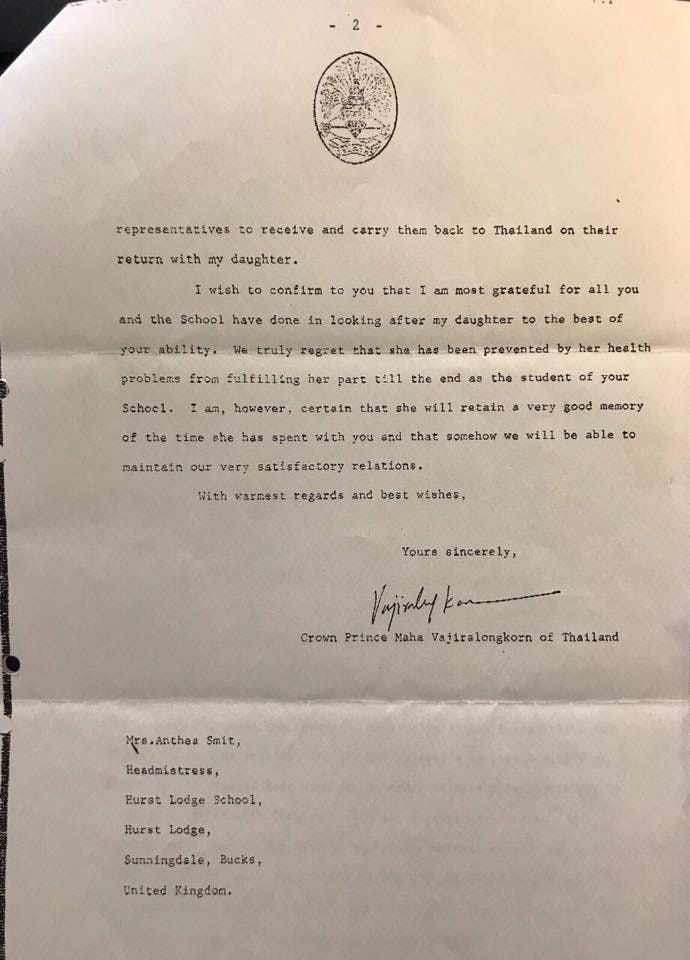
On May 13, 1996, Vajiralongkorn wrote to the headmistress of Hurst Lodge School in England, where his daughter Busyampetch was studying, to say he wanted to immediately bring her back to Thailand, supposedly for health reasons. He flew to London to collect her, but refused to see any of his sons who were also at boarding schools in England.
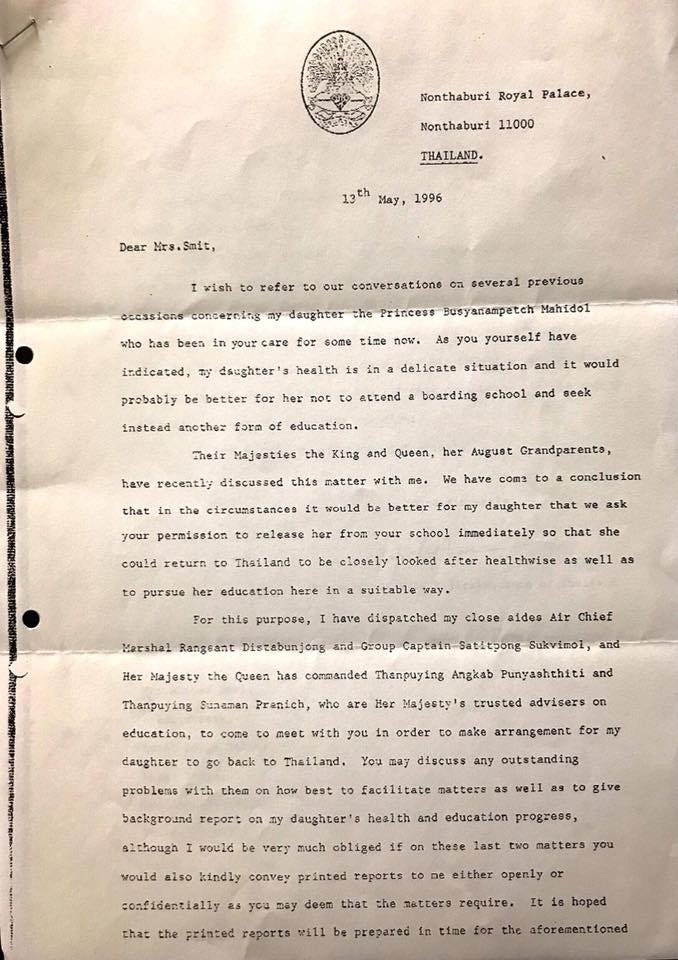
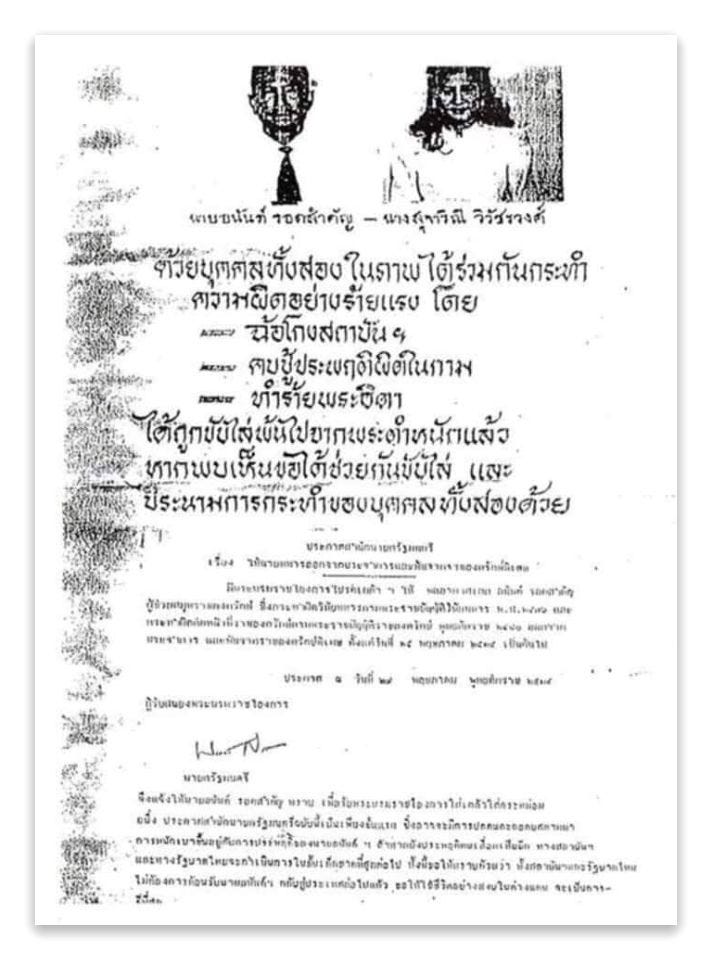
Vajiralongkorn and Busyampetch arrived back in Bangkok on May 26. Two days later, Vajiralongkorn formally exiled Yuvathida from Thailand. Leaflets were distributed in Bangkok and displayed on the walls of the palace claiming that Yuvathida had committed adultery with one of Vajiralongkorn’s aides and had mistreated Busyampetch. According to Handley, naked photographs of Yuvathida were also “sent by diskette to embassies and newspapers and posted on the Internet”.
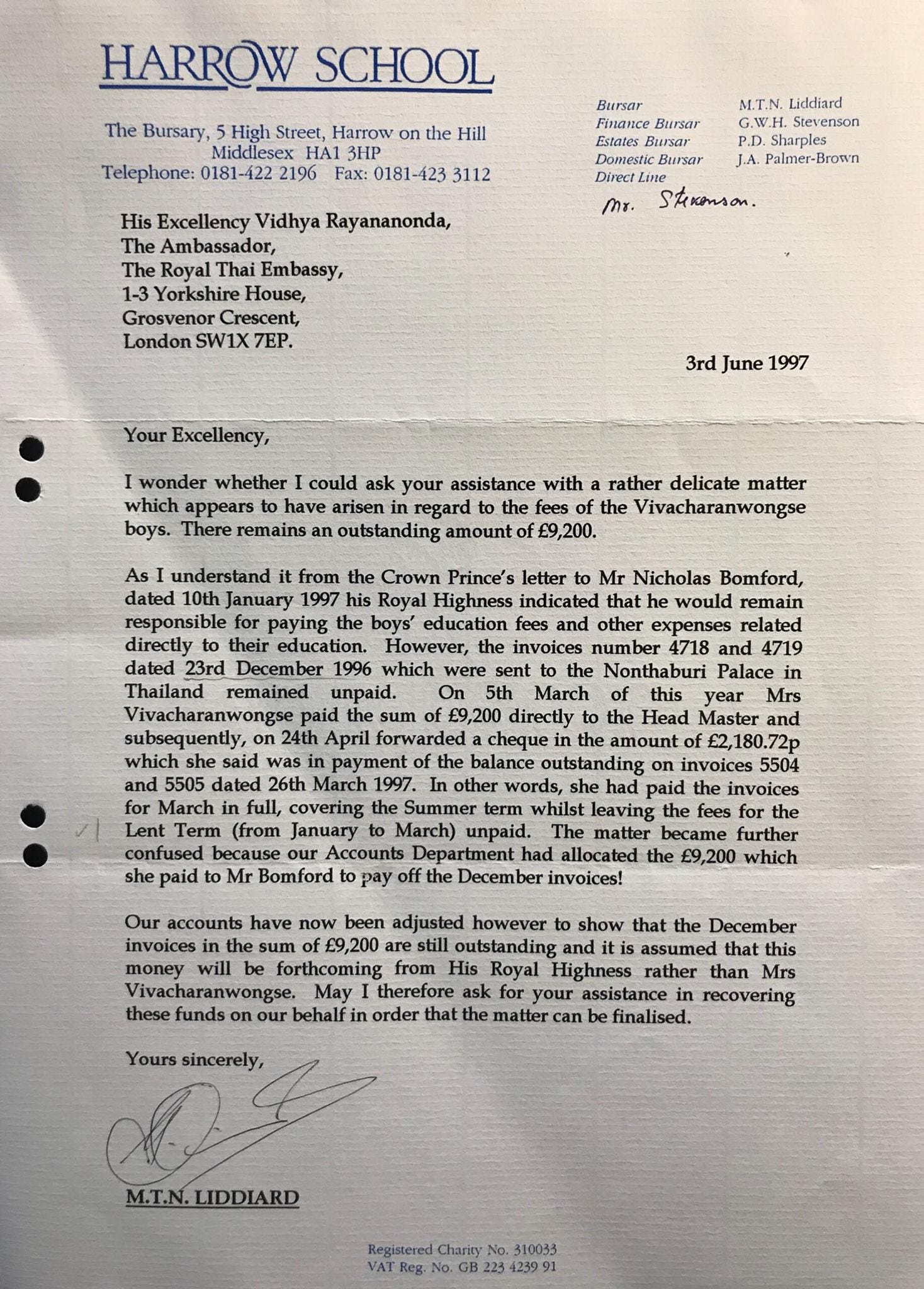
It soon became clear that Vajiralongkorn had not only expelled Yuvathida, but also their sons. In January 1997 he wrote to the headmasters of their schools in England, saying the four boys had been stripped of their royal titles and diplomatic passports, but promising that he would still continue paying for their education.
The letter below was sent to Nicholas Bomford, headmaster of Harrow, where his two eldest sons Juthavachara and Vacharaesorn were studying. Vajiralongkorn bizarrely and dishonestly claimed that Britain’s Queen Elizabeth II had “total understanding” and “complete sympathy” about his behaviour towards his sons.

By February, Vajiralongkorn had decided that he was not even going to pay their school fees, as he explained in another letter to Bomford. Similar letters were sent to the headmasters of Pangbourne College, where Chakriwat was studying, and Vatchrawee’s school Sunningdale.
Harrow School ended up having to contact the Thai embassy to ask for payment of overdue fees. Eventually, Yuvathida paid £9,200 and then Vajiralongkorn sent the Thai embassy £10,141.04 to cover the rest.
Yuvathida settled in Florida with the four boys. In an open letter in February 1998, seeking to address gossip and tell their side of the story, the four sons said Vajiralongkorn had never treated Yuvathida as a wife, and routinely forced her out of the palace when he had a new favourite concubine. They reported that during his abduction of Busyampetch, Vajiralongkorn had told Yuvathida that “the boys … were not important to him at this point”. And they accused him — correctly — of “trying to erase us from the memories of all who knew us”.
The heartbreaking letter is really worth reading in full. You can download it at the link below.
The reason for Vajiralongkorn’s vindictive and neglectful behaviour was that in order to get Sirikit’s blessing to abandon Yuvathida, he also had to sacrifice his relationship with his sons.
His daughter Busyampetch finished her school education in Bangkok and then received a degree from Chulalongkorn University. For unknown — but presumably superstitious — reasons, her name was changed twice, and she is now known as Sirivannavari.
With Vajiralongkorn’s male children banished, Bajrakitiyabha was once again the heir presumptive. Her position seemed secure because it seemed unlikely Vajiralongkorn would have any more children — in the late 1990s he had a vasectomy and also was infected with HIV.
Bajrakitiyabha established strong academic credentials, gaining a Master of Laws degree from Cornell Law School in 2002 and a Doctor of Juridical Science degree from Cornell University in 2005.
But by now, there had been a new development in the game of thrones.
3. An heir from nowhere
Srirasmi was desperate to have a child with Vajiralongkorn to secure her position, and eventually he agreed. Using IVF and the “sperm washing” technique to prevent transmission of HIV, a child was conceived, and on April 29, 2005, Dipangkorn Rasmijoti was born. The Chakri dynasty had a male heir once again.

Sirikit was blindsided — she had assumed there could be no further challenge to the primacy of Bajrakitiyabha in the line of succession, but suddenly an unexpected male heir had appeared out of nowhere.
This led to another vicious bout of infighting among competing royal factions. To try to discredit Srirasmi, a video was leaked in 2007 showing her virtually naked at her 30th birthday party at Nonthaburi Palace in the presence of numerous courtiers as the crown prince contentedly puffed on his pipe.
A confidential US cable noted that “the Crown Prince’s reputation continues to suffer and may have declined further, in part due to the dissemination online and by DVD of material harmful to the image of the Crown Prince and his Royal Consort”, and added: “some in palace circles are working actively to undercut whatever support exists for the Royal Consort, and we assume that this undercurrent also has implications for the Crown Prince”. In July, while Vajiralongkorn and Srirasmi were in Europe, very high-level sources spread misinformation that Vajiralongkorn had died of AIDS.
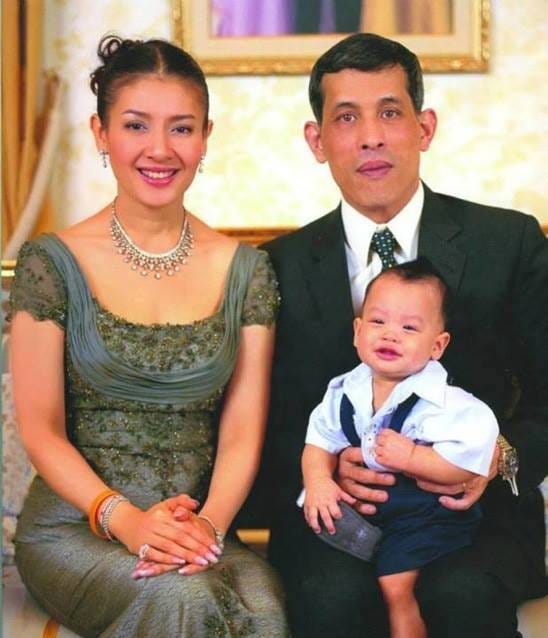
Meanwhile, Vajiralongkorn had already grown bored of Srirasmi. He had a new favourite — Thai Airways flight attendant Suthida Tidjai, who he met when she was among the cabin crew on a charity flight he piloted on January 5, 2007. Later in the year he moved to Germany to live in Munich with Suthida, only returning to Thailand occasionally for royal duties.
According to a secret US cable, Queen Sirikit finally gave up on supporting her son in 2007, after many years in which she had “actively promoted Crown Prince Vajiralongkorn's interests and was seen as his greatest backer in the face of widespread public opposition”. The cable said “the mother-son relationship suddenly changed in 2007” and that in March 2008 “the Queen and the Crown Prince had a shouting match at a hospital during the Queen's brief hospitalization, with the Crown Prince angrily berating her in front of ladies-in-waiting”.
Sirikit was increasingly losing touch with reality, and believed that in a former life she had been the 16th century Ayutthayan queen Sri Suriyothai, who supposedly died heroically after she disguised herself as a man and rode into battle on an elephant to save the kingdom during the Burmese-Siamese War of 1548.
She became determined to reign herself after Bhumibol died, rather than allowing Vajiralongkorn to become king, and began recklessly intervening in politics in support of the royalist movement fighting Thaksin Shinawatra. She also believed that her intervention would ensure that Bajrakitiyabha would become monarch after her, securing the primacy of the Kitiyakara bloodline.
But in July 2012, Sirikit collapsed while walking in the grounds of Siriraj Hospital in Bangkok. She had suffered a massive stroke, and has been incapacitated ever since. The woman who had dominated Vajiralongkorn’s life more than any other, and who had obsessively plotted about royal succession and ensuring the primacy of her own lineage, was no longer able to play any role in deciding the dynasty’s future.
By now, it had become clear that something was seriously wrong with Dipangkorn. A US cable in 2007 mentioned “rumours of autism” and another leaked cable in 2009 said he “appears to suffer from both physical and mental developmental delay issues and reportedly has regular seizures”. Over the following years, the evidence grew that Dipangkorn has a condition that has significantly affected his development and cognitive abilities. He appears to be severely autistic although this has never been officially confirmed.
In late 2014, with Bhumibol increasingly incapacitated too, Vajiralongkorn decided to divorce Srirasmi, who he had already abandoned years before. She was stripped of her royal titles, banished to house arrest in Ratchaburi, and most of her close relatives were jailed.
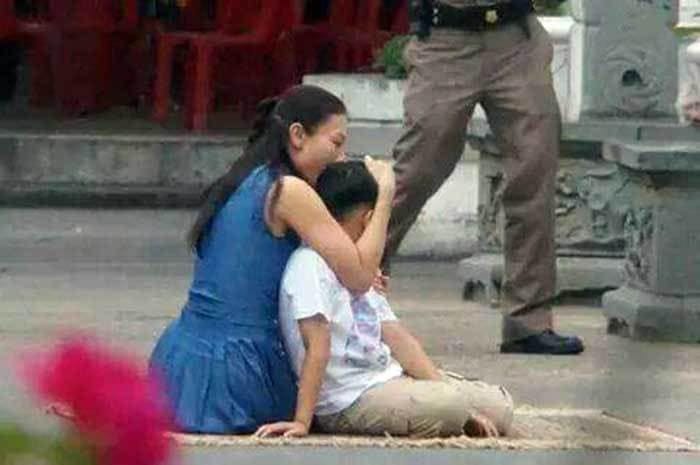
But unlike Yuvathida’s four sons, Dipangkorn was not expelled from the royal family. He was removed from Srirasmi’s care and enrolled in a special school in Geretsried outside Munich.
4. A monarch or a regent
By the time of her sudden and shocking health emergency last week, Bajrakitiyabha was the most powerful member of the royal family after Vajiralongkorn himself.
She seemed destined to reach the pinnacle of the palace hierarchy. The only question was whether she would become monarch herself after Vajiralongkorn died, or would reign as regent on behalf of her younger half-brother Dipangkorn.
After Bajrakitiyabha graduated from Cornell, the palace continued to groom her to be a potential monarch. She was installed in the Office of the Attorney General, first in Bangkok and then in Udon Thani. She was also promoted as a prison reform activist fighting for the rights of women in jail, and according to palace propaganda she was instrumental in getting the United Nations to agree the so-called “Bangkok rules” on humane treatment of female prisoners.
Bajrakitiyabha was made Thai ambassador to Austria in 2012, and in 2017 the Thai regime somehow managed to get the United Nations Office on Drugs and Crime to appoint her as “Goodwill Ambassador for the Rule of Law in Southeast Asia” despite the criminality of Vajiralongkorn and his enablers in the palace. Last year, Bajrakitiyabha was given the rank of general in the Royal Guard, another sign of Vajiralongkorn’s support for her. She did military training at the Special Warfare Command in Lopburi, including a parachute jump, and started sporting a short army-style haircut.
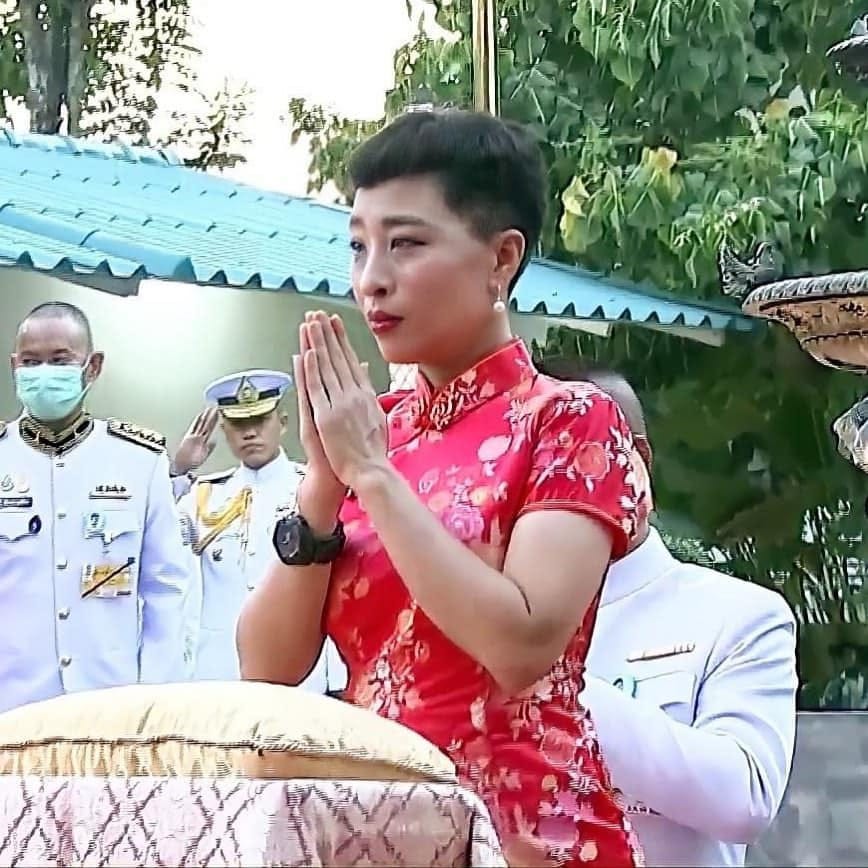
Had she been male, there would have been no doubt that Bajrakitiyabha would have been heir to the throne.
But the Palace Law that governs the palace and the rules of succession, initially codified in the Ayutthaya kingdom six centuries ago, and revised by King Vajiravudh, Rama VI of Siam, in 1924, forbids a woman from reigning as a monarch. Article 13 of the 1924 law states:
For the moment, it is still not appropriate for a woman to accede to the throne as a sovereign queen.
However, this was not as big a barrier as it may seem. Since 1974, successive Thai constitutions have allowed the possibility of a female monarch, if she is a daughter of the previous monarch. This change was requested by the palace. After the end of the era of Thai royal polygamy, with monarchs having far fewer offspring, it was sensible for the Chakri monarchy to follow most other royal families around the world to allow female succession, because otherwise there was a risk of the dynasty ending if a king had no sons, only daughters.
Although the Palace Law still forbids a woman from reigning as monarch, this is not an obstacle because Vajiralongkorn could just change the law whenever he wants, and if he dies suddenly, the head of the Privy Council — a group of ancient male royalists who supposedly advise the monarchy — could change it too.
So there is no longer any real constitutional obstacle to a woman becoming monarch of Thailand.
A much bigger barrier is the extreme conservatism of Thai royalists. Their values remain mired in the past and many of them would be appalled at the idea of a female monarch. They would see it as a shocking violation of the ancient traditions of the kingdom.
So for years it has been widely assumed that Dipangkorn was the heir presumptive.
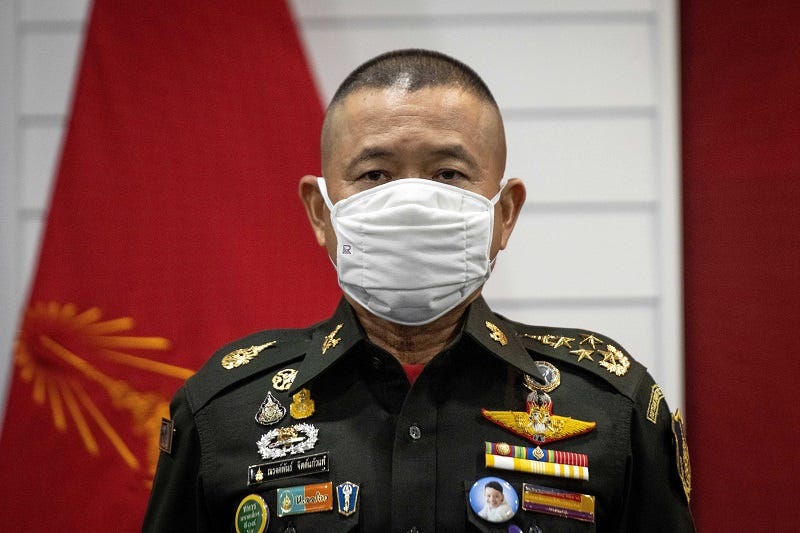
After Vajiralongkorn became king following Bhumibol’s death in 2016, soldiers, police and officials in his inner circle began wearing badges showing Dipangkorn’s face. These badges are personally awarded by Vajiralongkorn to those he regards as most loyal to him, and this was widely interpreted as a signal that Dipangkorn was the king’s chosen successor.
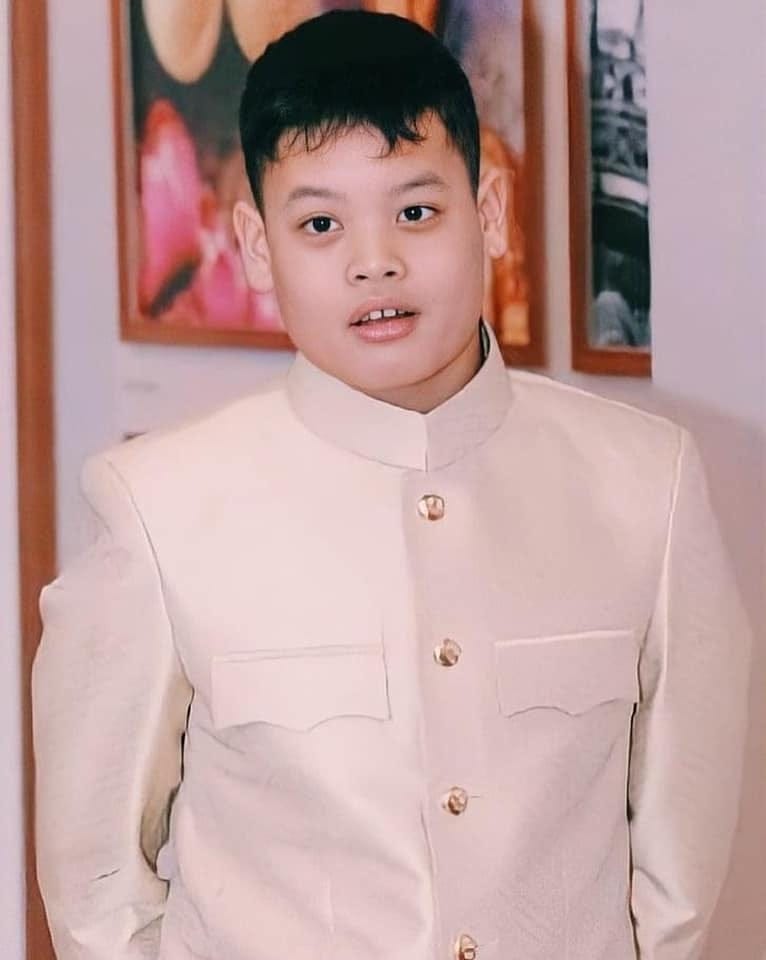
But there is no way Dipangkorn can ever reign alone. He is now 17 years old, and although he has been often featured on daily royal news broadcasts, he’s never been shown uttering a coherent sentence. He attends a school in Germany for children with developmental problems. Unlike Bajrakitiyabha and Sirivannavari, who have been showered with praise by the palace propaganda machine for their alleged genius in multiple skills since they were children, despite showing little talent in any field, there has not been any attempt to claim that Dipangkorn has any special talents at all.
Obviously none of this is his fault, but clearly he will need significant help if he ever becomes monarch, and in particular somebody who can act as regent and do most royal duties on his behalf. So the consensus among analysts of Thailand was that if Bajrakitiyabha was denied the chance to become monarch herself, because of her gender, she would at least be regent.
Now, none of this will ever happen, and it’s a disaster for the Thai monarchy. They have lost the person best suited to navigate the royal succession after Vajiralongkorn dies.
Her death will have other more immediate repercussions for the royals. Bajrakitiyabha was the most important ally and supporter of Queen Suthida. They were both the same age, and became good friends. After Vajiralongkorn became besotted with a new mistress, Sineenat “Koi” Wongvajirabhakdi, and appointed her as his official “noble consort” on his 67th birthday in July 2019 in a special ceremony with Suthida looking on aghast, it was Bajrakitiyabha who fought to protect the queen’s position.
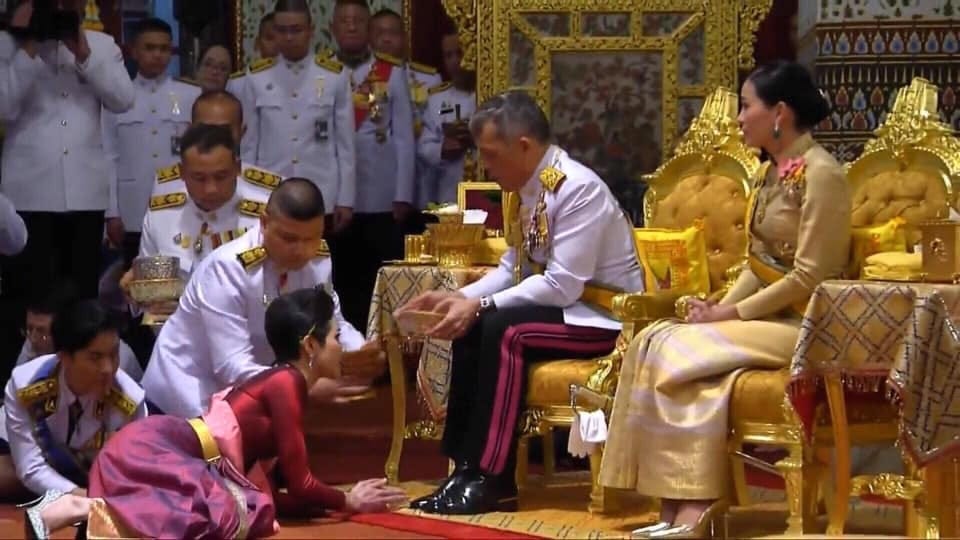
The factional battles in the palace escalated, with Koi seeking equal status with Suthida, and Bajrakitiyabha defending the queen. Eventually an exasperated Vajiralongkorn stripped Koi of her titles in October 2019, just three months after making her his consort, and flung her into the Central Women’s Correctional Institution at Klong Prem Prison, also known as Lat Yao.
By August 2020, Vajiralongkorn was having second thoughts. He decided to forgive Koi. She was freed from prison and flown to Munich on one of Vajiralongkorn’s personal Boeing 737 aircraft. He went to meet her at the airport, dressed in one of his infamous crop tops.
As Koi’s influence over the king grew, she again began pressuring him to raise her status in the royal family even higher. Not content with being a royal noble consort, she implored him to elevate her to the rank of queen.
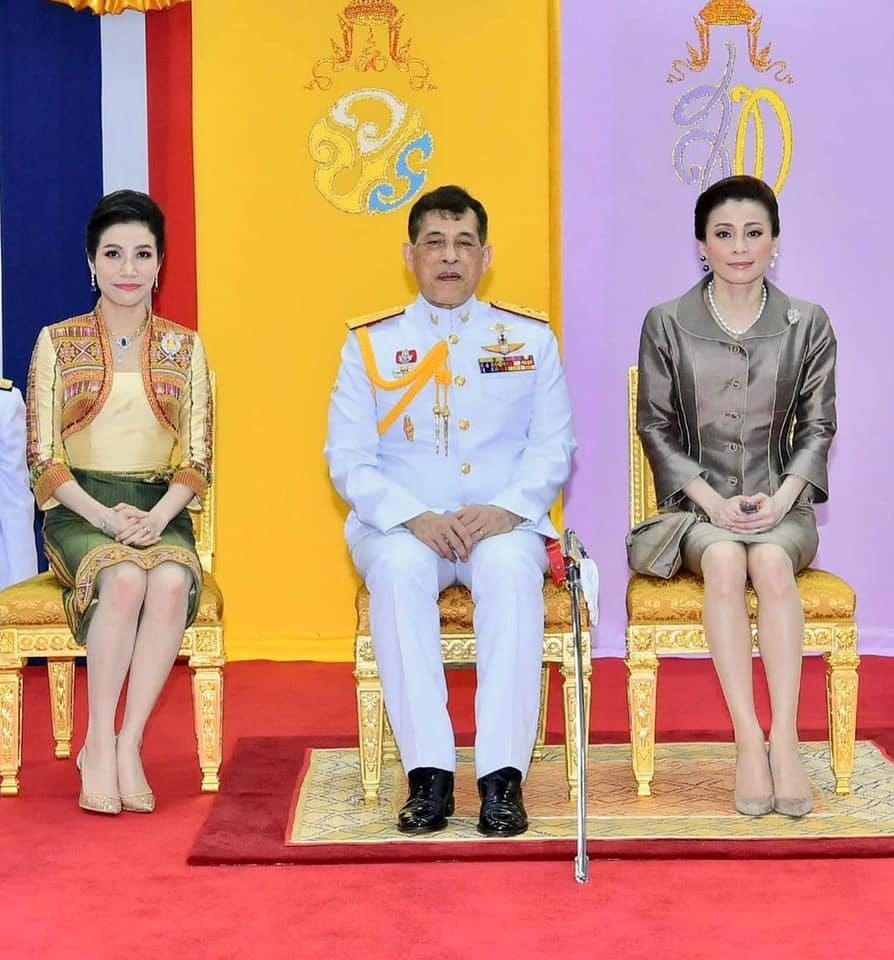
According to senior palace sources, the lovestruck Vajiralongkorn initially agreed, and intended to hold a ceremony on Koi’s birthday on January 26, 2021, to bestow the title upon her. But the plan was furiously opposed by Bajrakitiyabha. Vajiralongkorn reluctantly backed down. (You can read my article on the rise and fall of Koi here.)
Koi has not been seen in public in Thailand for more than a year. Sources say she was sent back to live in the king’s vast residence in the Bavarian resort of Garmisch-Partenkirchen — the Grand Hotel Sonnenbichl. But with Bajrakitiyabha out of the picture, the notoriously fickle Vajiralongkorn may seek to rekindle his relationship with his noble consort. Suthida has lost her main protector in her rivalry with Koi.
Bajrakitiyabha was one of the few people able to stand up to Vajiralongkorn and manage his erratic and mercurial behaviour. Now her influence is gone, he may well spiral even more out of control, with nobody able to reason with him.
Bajrakitiyabha’s death will be profoundly destabilising for the monarchy.
5. What now?
The loss of Bajrakitiyabha has thrown royal succession planning into disarray.
The overwhelming likelihood now is that Dipangkorn will indeed become Rama XI, alongside a regent. The most probable scenario is that one of Vajiralongkorn’s most trusted allies, such as the hawkish ultraroyalist former army chief Apirat Kongsompong or the king’s longstanding sidekick Satitpong Sukvimol, will be made head of the Privy Council and will be regent for Dipangkorn after the succession.
Dipangkorn would be a puppet king manipulated by some of the worst elements of the royalist military cabal. It would cement the fusion of ultraroyalist military officers and the monarchy, which is already well under way during the reign of Rama X, to produce an even ghastlier regime than we have seen before.
This is a nightmare scenario for Thai democracy but unfortunately it’s also the likeliest outcome now.
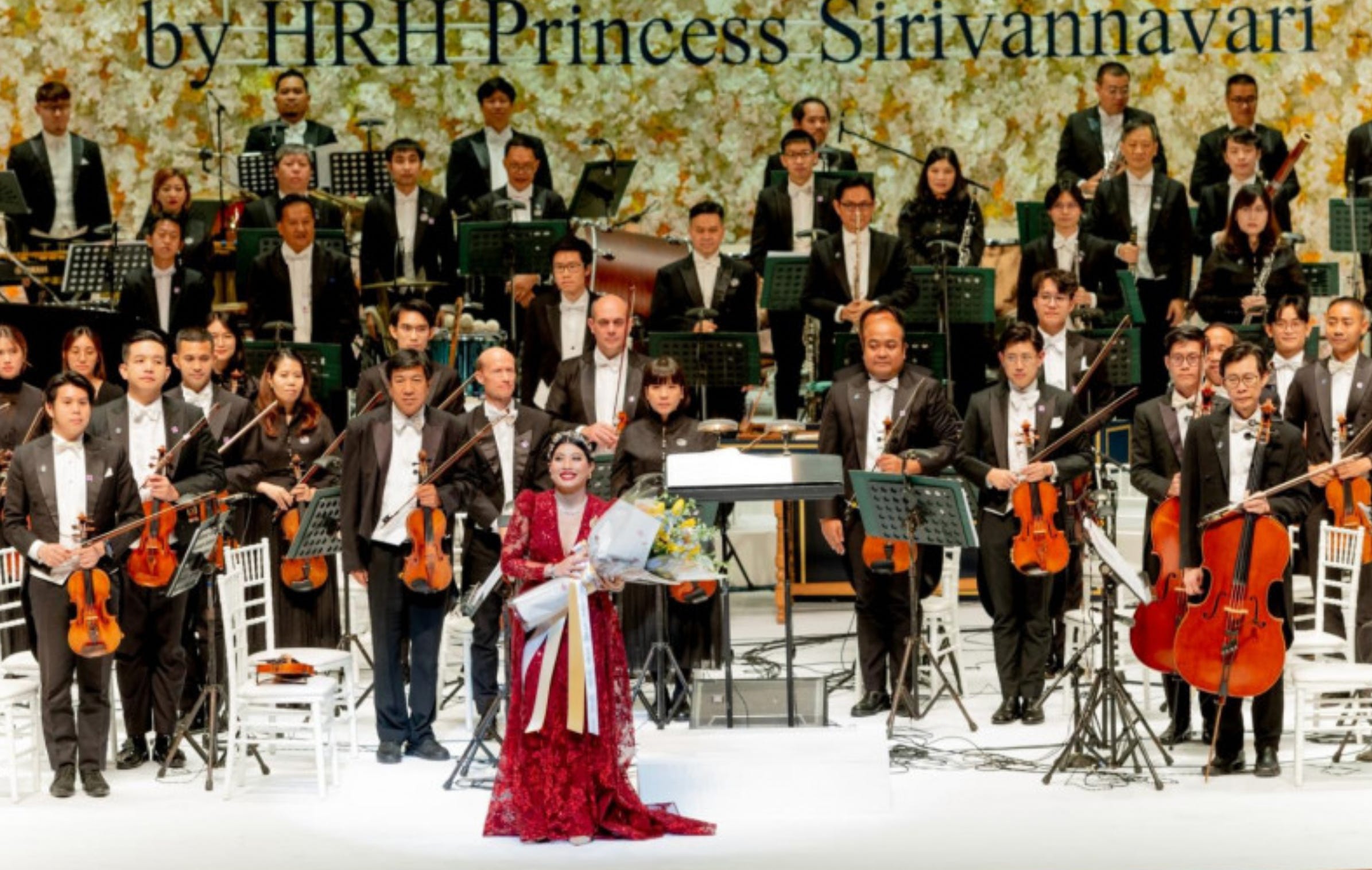
In theory, Sirivannavari now has an elevated claim to the throne now that her older half-sister is gone. But the prospects of her ever becoming monarch are extremely remote. She is petulant and spoiled, hated by most Thais, and totally unsuitable to be monarch, or regent for Dipangkorn.
Ever since Vajiralongkorn kidnapped her in the UK and brought her back to Thailand in 1996, she has been indulged and praised and hailed as a genius in sport, fashion and music. As a favour to her grandmother Sirikit, who spent millions of dollars on Balmain couture over the years, the French fashion house helped her launch her first Paris fashion show in 2007. But the Sirivannavari fashion brand has hardly any traction outside Thailand and is widely regarded as derivative and absurd.
In her efforts to pretend she’s an amazing polymath she has also started presenting symphonies she claims she has composed. The latest one was just a few weeks ago.
Her habit of getting whole swathes of southern Thailand shut down when she wanted to go on a beach holiday with her friends has infuriated many Thais, and even the most ardent supporters of Vajiralongkorn acknowledge it would be a catastrophe for her to get anywhere nearer the throne.
Arguably, if Dipangkorn and Sirivannavari are bypassed, then the next candidates would be Vajiralongkorn’s younger sisters, Sirindhorn and Chulabhorn.
Sirindhorn is the most popular royal in the kingdom by some margin but she is already 67 and has no children. Chulabhorn is extremely unpopular, often appears incapacitated, and her two daughters would not be able to succeed her under the current constitution. There is no credible possibility that either Sirindhorn and Chulabhorn will ever be monarch.
But if all these — highly unsatisfactory — candidates are ruled out, then that will be the end of the Mahidol reigning dynasty.
The crown would move to the rival Yugala bloodline, something that Vajiralongkorn will be desperate to try to avoid.
All the wealth and influence of the Mahidol family would vanish. The Yugala clan would inherit it all.
It will be exceptionally difficult for Vajiralongkorn to avert the end of the Mahidol era. The only two candidates to succeed him now are Dipangkorn or Sirivannavari, both of whom are far from ideal. Even if he manages to ensure that one of them succeeds him as monarch, neither of them have any children and it’s unclear if they ever will.
Vajiralongkorn has only one grandchild, born to estranged son Juthavachara Vivacharawongse and his American wife Riya Gough. According to Thai palace and constitutional law, marrying a foreigner or having a foreign parent disqualifies any candidate for the throne from becoming monarch.
So the Mahidol bloodline has no long-term plan at all. The Yugala clan are quietly gleeful about the prospect of providing the future monarchs of Thailand. But given shifting social attitudes in Thailand it’s not clear if the public would accept the transfer of the crown to another unpopular line of entitled aristocrats.
There’s one wild card possibility. One the biggest ironies in the ghastly chronicle of recent Thai palace history is that the four sons banished by Vajiralongkorn along with their mother Yuvathida grew up to be by far the best and most impressive members of the Thai royal family. Expelled from the stifling embrace of the palace and forced to fend for themselves in the United States with minimal financial support, they all established successful careers.
Over the years, there has been persistent speculation that Vajiralongkorn’s exiled sons could be brought back into the line of succession. The rumours were mentioned in secret US cables, and there have been various attempts by palace factions to reach out to the brothers.
But three of the four brothers have repeatedly made it clear that they have no intention of ever taking a formal royal role, although they would like to at least have their existence acknowledged by their father and be allowed to visit Thailand after a quarter century of exile.
The exception is Vacharaesorn, the second son of Vajiralongkorn, who is theoretically first in the line of succession among the brothers following Juthavachara’s marriage to a US woman. He’s a highly successful lawyer in New York, he has an active Facebook profile, and he launched various charity fundraising initiatives in recent years. Although it remains unlikely, there is a possibility he could be a potential successor to his father.
Meanwhile, Vajiralongkorn is looking increasingly unwell. He has to be physically supported by Suthida during public appearances, and he is stooped and shrunken. It’s possible he might continue for years, but it’s also possible he could die suddenly before any official heir is announced, which would lead to turmoil in Thailand.
We are witnessing the death throes of a dynasty.
as always, meticulously researched and documented reporting- Andrew, it saddens me to see you pilloried so frequently as you have tweeted and posted re the Princess, it seems that many Thais are unwilling to stop drinking the royalist cult Koolaid... that said, please continue to do what you do- the truth must be told, even if many do not want to hear it!
Fascinating